

Blog Academy → Step 4B: Authority → Audience Journey (Inspired)
You’ve chosen the Authority path. Now flip perspectives: this is your audience’s journey for this path—and how to design for it.
When you choose to be a voice of authority, your role is bigger than teaching skills or sharing hobbies. It’s about becoming a voice that cuts through the noise—a voice people trust to help them see the world differently.
But just as you have a journey, so does your audience.
We call this the Inspired Journey—the psychological path your audience takes when they encounter a perspective that doesn’t just inform them but inspires them; challenges their assumptions, broadens their perspective, and gives them a reason to follow.
Every audience journey has a moment of conversion—the point where attention turns into action.
In the Inspired Journey, conversion happens when someone doesn’t just find your ideas profound—their mind is shaped by them.
It’s when they buy your book, register for your workshop, or commit to learning directly from you.
It’s the shift from “that person says interesting things” to “this voice guides me.”
Your goal as a creator is to design for that moment—and then nurture what happens after.
These voices shape the future
The Inspired Journey isn’t new. Humans have always looked to voices that could make sense of the world and guide them toward meaning:
- Religious figures who carried faith across generations.
- Philosophers like Socrates and Plato, who taught us to question.
- Leaders like Gandhi, Martin Luther King Jr., and John F. Kennedy, who mobilized movements with words.
- Today, it’s voices like Simon Sinek, Brené Brown, and podcasters who bring fresh, bold perspectives into crowded conversations.
What unites them isn’t just knowledge—it’s the ability to cut through when others talk in unison. They offer clarity when the world is noisy, conviction when the crowd drifts, and vision when others recycle the same ideas.
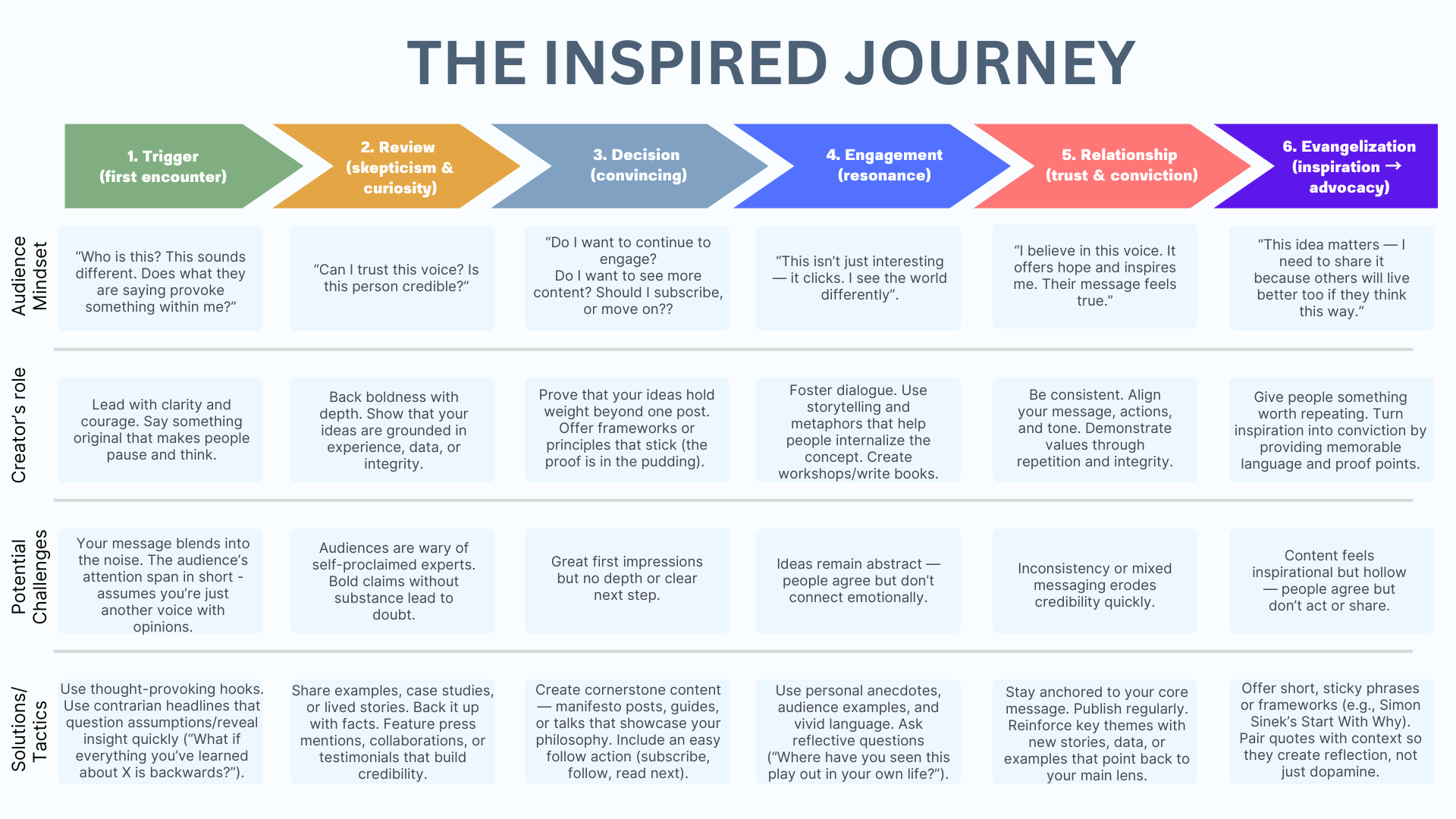
Stage 1: Trigger (first encounter)
- Audience mindset: “Who is this? This sounds different. Does what they’re saying provoke something in me?”
- Your role: Lead with clarity and courage. Say something original that makes people pause and think.
Stage 2: Review (skepticism & curiosity)
- Audience mindset: “Can I trust this voice? Is this person credible?”
- Your role: Back boldness with depth. Show that your ideas are grounded in experience, data, or integrity.
Stage 3: Decision (convincing)
- Audience mindset: “Do I want to continue engaging? Should I subscribe, follow, or move on?”
- Your role: Prove that your ideas hold weight beyond one post. Offer cornerstone content—frameworks or principles that stick.
Stage 4: Engagement (resonance)
- Audience mindset: “This isn’t just interesting—it clicks. I see the world differently.”
- Your role: Foster dialogue. Use storytelling and metaphors that help people internalize your message. Create workshops, write books, or host discussions.
Stage 5: Relationship (trust & conviction)
- Audience mindset: “I believe in this voice. It offers hope and inspires me. Their message feels true.”
- Your role: Stay consistent—in message, action, and tone. Demonstrate your values through repetition and integrity.
Stage 6: Evangelization (inspiration → advocacy)
Your audience doesn’t just consume—they carry your message forward. But not all inspiration works.
Online, we see endless “inspirational” posts that make readers say, “Huh, that’s nice,” and then scroll away. No conviction, no share.
The voices that truly cut through—those that last—do three things:
- Clarity + Courage
- They say something simple, but not simplistic. They risk being bold.
- Example: Simon Sinek’s Start With Why became a lasting lens for leadership.
- Embodiment
- They live what they preach. Consistency between message and behavior builds trust.
- Tools for Application
- They give people handles—frameworks or phrases they can use.
- Example: Chris Voss’s “That’s right.” Brené Brown’s “Daring greatly.”
When those elements combine, inspiration becomes conviction—and conviction turns followers into advocates who share your ideas proudly, not to flatter you, but because it reflects their own growth and insight.
What’s unique about this journey
The Inspired Journey is about meaning.
Your audience isn’t drawn only to what you know; they’re drawn to who you are, what you stand for, and how you help them see the world differently.
That’s what sustains trust and respect over time.
📝 Your Turn
Reflect on the map above:
- What could you say or share that would stop someone mid-scroll and make them think differently?
- What values or principles are you willing to stand for publicly—the ones your audience should recognize as your lens?
- Where do you already show alignment between your words and actions?
Next up in the Academy: we’ll move from journeys into building your audience persona—the exercise that gives shape to the people you most want to inspire, so you can speak directly to their needs, doubts, and hopes.


 Knock Knock WHOIS There