
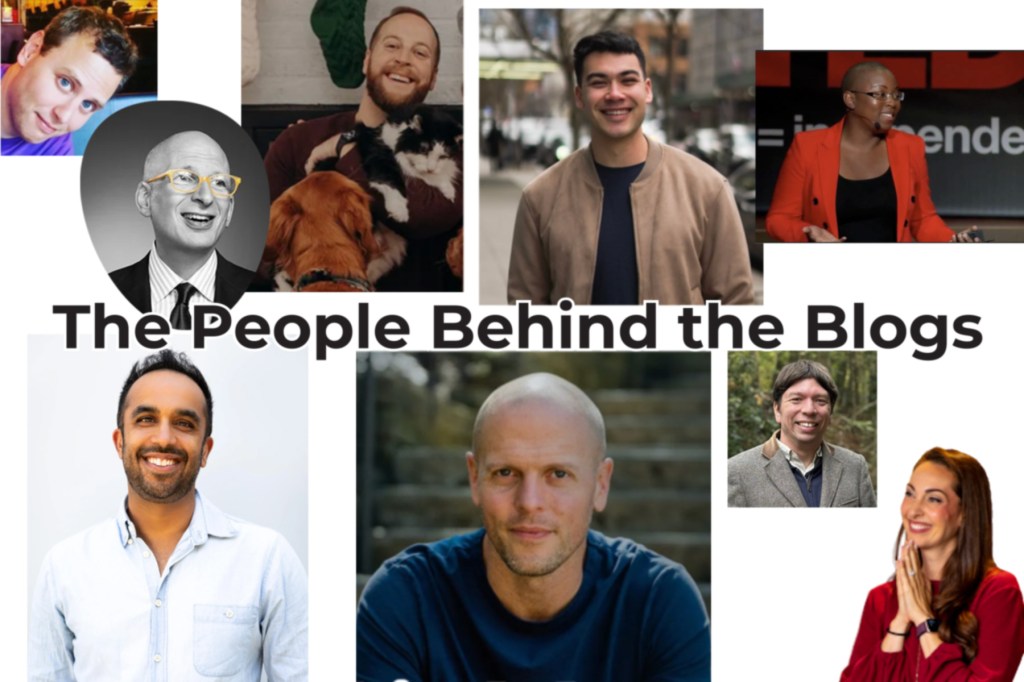
Personal brands get built in all kinds of places — books, podcasts, newsletters, YouTube channels, social feeds. The ten writers featured here use all of them. What they share is a deliberate choice to give their work a permanent home on a domain they own.
A personal website gives creators, founders, writers, and experts a permanent address for their ideas — and a .blog domain makes that address personal: your name, followed by a word that tells people exactly what they’ll find there.
Here are ten of our favorite people on .blog who have built influential personal brands and use a .blog domain as the home for their ideas, expertise, and audience.
1. Seth Godin — seths.blog
Focus: marketing, leadership, creativity.
seths.blog is Seth Godin’s long-running daily blog, one of the most widely read marketing and business blogs in the world. He posts short, punchy reflections every day on topics such as marketing, leadership, creativity, and the spread of people and ideas.
In 2018 he moved nearly two decades of archives from Typepad to seths.blog, redirects and all. Typepad has since shut down entirely, but Seth’s writing, and every link pointing to it, kept working.
Why it works:
- Publishes daily
- Extremely recognizable voice
- Short, focused posts
Takeaway:
Seth has spent decades proving that you don’t need to chase every new platform to stay relevant. By consistently publishing thoughtful ideas on his own website, he’s built one of the most recognizable personal brands in marketing.
2. Tim Ferriss — tim.blog
Focus: entrepreneurship, learning, performance.
Tim Ferriss built one of the most recognizable personal brands in modern entrepreneurship through books, podcasting, experiments, interviews, and long-form publishing. His .blog domain gives that ecosystem a simple, memorable home.
Why it works:
- Rich content ecosystem
- Blog, podcast, newsletter working together
- Strong archive value
Takeaway:
The best blogs become intellectual property libraries that keep delivering value years after publication. While social posts disappear into the feed, a well-maintained website becomes a long-term business asset.
3. Vanessa Van Edwards — vanessa.blog
Focus: communication, human behavior, and people skills.
Vanessa Van Edwards, a best-selling author, specializes in studying hidden social signals, micro-expressions, and body language to teach science-backed people skills.
vanessa.blog works as the hub of her personal brand. It points visitors to her courses at Science of People, her YouTube channel, and her recent appearances. The domain carries the personal, approachable side of her brand, while the commercial side lives elsewhere.
Why it works:
- A first-name domain that’s instantly memorable
- Science-backed expertise
- Strong educational content
Takeaway:
A personal domain doesn’t have to host a traditional blog. Vanessa uses vanessa.blog as the front door to everything she does.
4. Neil Pasricha — neil.blog
Focus: happiness, resilience, gratitude, and intentional living.
Neil Pasricha’s story starts in the golden age of blogging. In 2008 he began posting one small joy every weekday on a blog called 1000 Awesome Things, and kept it up for a thousand straight weekdays. The blog won a Webby, drew more than 100 million visits, and became The Book of Awesome, the first of ten books that have sold over 2 million copies worldwide.
Today he writes about gratitude, happiness, resilience, and intentional living at neil.blog. His career began with a blog, and now his writing lives at his own name.
Why it works:
- Consistent thematic focus
- Personal storytelling backed by research
- Strong emotional connection with readers
- A simple first-name domain that matches a personal body of work
Takeaway:
A personal brand becomes stronger when it consistently returns to a clear set of values. Neil has spent years exploring themes like gratitude, resilience, and happiness from different angles, creating a body of work that feels both authentic and enduring.
5. Noah Smith — noahpinion.blog
Focus: economics, technology, public policy.
Noahpinion began in 2011 as a free Blogspot blog, written while Noah Smith was still an economics PhD student. The name stuck through his years as a Bloomberg Opinion columnist and a move to Substack, where it is now one of the most-read economics publications on the internet, with over 450,000 subscribers getting his long-form takes on economics, technology, and policy at noahpinion.blog.
Why it works:
- Deep expertise
- Long-form content
- Strong newsletter integration
- Publication and domain share one name
Takeaway:
Noah demonstrates that a blog can grow into a full-scale publication without ever changing its name. Expertise attracts attention when it’s consistently published and easy to find.
6. Phil Rosen — philrosen.blog
Focus: finance and independent journalism.
Phil Rosen is an award-winning journalist who left a senior reporter role at Business Insider in 2024 to co-found Opening Bell Daily, an independent financial news outlet. philrosen.blog runs alongside it as the personal side of the story, where he has written since 2018 about work, careers, and what it’s like to build a media company from the inside.
Why it works:
- Niche expertise
- Distinct voice
- Direct audience relationship
Takeaway:
Your main project doesn’t have to be your personal brand. A blog under your own name can sit alongside the business and tell the story only you can tell.
7. Jay Clouse — jay.blog
Focus: the creator economy, trust, and audience building.
Jay Clouse is best known for Creator Science, his media company about the business of being a creator, built on a newsletter, a podcast, and a membership community. jay.blog is the personal layer beside it: his own blog, at his own first name, where he writes about what eight-plus years of helping creators has taught him about earning trust. When your job is teaching people to publish, keeping your own blog is the proof.
Why it works:
- Clean identity
- Strong connection between individual and domain
- Easy recall
Takeaway:
The simpler the path between your name and your content, the easier it becomes for people to remember you.
8. Felecia Hatcher — genius.blog
Focus: creativity, personal development, ideas.
Felecia Hatcher’s resume reads like several careers in one: marketing executive for Nintendo and Sony, co-owner of a gourmet popsicle company, co-founder of Code Fever and Black Tech Week, and now CEO of Black Ambition, the nonprofit founded by Pharrell Williams to fund Black and Latinx entrepreneurs. The thread running through all of it is helping people unlock their genius, which is exactly what her domain says.
The blog itself is refreshingly informal. Her polished professional site lives at feleciahatcher.com, while genius.blog, tagged “Occasional Advice and Ramblings,” is where she thinks out loud, with recent posts wandering from failure capital to radical self-care.
Why it works:
- Strong identity
- Clear thematic focus
- Memorable domain
Takeaway:
A great domain name helps people remember where to find you. But the best ones, like Felecia’s, also tell people what you stand for.
9. Paolo Belcastro — paolo.blog
Focus: leadership, organizational design, digital transformation.
Full disclosure: Paolo is one of ours. He has led .blog since it launched, and before that spent decades building software and leading distributed teams. We would have put him on this list anyway, because few people live the case for personal blogging as thoroughly as he does.
His archive ranges from essays on management and time to AI experiments, photography, and writing that is simply about his life. When one blog stopped being enough, he started two more, a newsletter for leaders at ttl.blog and his black-and-white photography at monochrome.blog.
Why it works:
- Combines personal experiences with professional insights
- Writes about whatever genuinely interests him, from management to photography
- Reinforces expertise through long-form thinking
Takeaway:
A personal site works like a living CV. Years of thinking collected in one place, under your own name, says more about how you work than any bio could.
10. Dominic Self — dom.blog
Focus: travel, books, and everyday life, since 2004.
Dominic Self has been writing dom.blog since 2004, more than two decades of continuous personal blogging. It’s a personal blog in the classic sense: travel writeups organised by continent, annual reviews, book notes, and an “On This Day” feature that surfaces what he wrote fifteen years ago. The footer says it best: “Still powered by tea.”
Why it works:
- Simple memorable domain
- Personality-driven content
- Twenty years of archives in one place
Takeaway:
Sometimes the most powerful brand asset is simply your own name.
These blogs cover different industries, audiences, and publishing styles.
Some attract millions of readers. Others serve highly specialized communities. Some publish every day. Others publish only when they have something meaningful to say.
What they all share is ownership of the address where their work lives.
They’ve each built a place where their ideas can live, grow, and be discovered for years to come.
The lesson isn’t that everyone needs to become the next Seth Godin or Tim Ferriss. It’s that a personal brand is stronger when it has a home of its own.
A personal website gives your ideas a permanent address. Whether you’re building a business, growing an audience, or simply sharing what you know, a domain that’s unmistakably yours is one of the smartest investments you can make in your personal brand.

 Knock Knock WHOIS There